
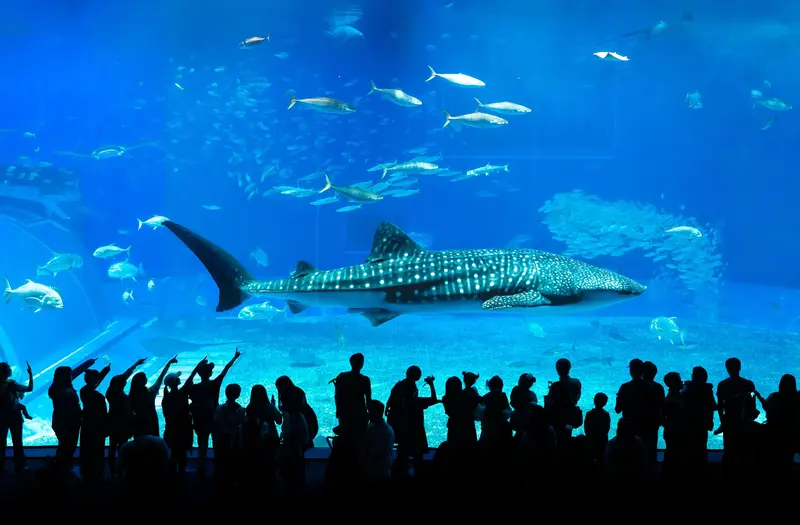
Okinawa Churaumi Aquarium is one of the world’s defining public aquariums and a destination that many visitors build an Okinawa itinerary around. The 7,500-cubic-metre Kuroshio Sea tank is the centrepiece, where whale sharks, manta rays and large schools of migratory fish move behind an enormous acrylic viewing window.
The aquarium follows the ecology of Okinawa from shallow coral reefs into the Kuroshio Current and then into the deep sea. The Kuroshio Sea tank is 10 metres deep, 35 metres wide and 27 metres long, while the Coral Sea uses natural light and fresh seawater to display living reef systems. Shark research, deep-sea animals and outdoor dolphin, manatee and sea-turtle facilities turn the visit into much more than one giant tank.
Quick planning summary
| Location | Ocean Expo Park, Motobu, Okinawa, Japan |
|---|---|
| Recommended time | 3–5 hours; allow most of a day with Ocean Expo Park |
| Best for | whale sharks, manta rays, marine biology, families and Okinawa road trips |
| Main areas | Coral Sea, Kuroshio Sea, Shark Research Lab, deep-sea exhibits, Aqua Room and outdoor dolphin/manatee/sea turtle areas |
Before travel, check the official Okinawa Churaumi Aquarium website for current hours, closures, ticket products and accessibility information.
What to prioritise
Kuroshio Sea
Kuroshio Sea is the 7,500-cubic-metre flagship tank with whale sharks, manta rays and roughly 80 exhibited species. View it from several levels and return later rather than stopping only at the first crowded window.
Whale shark and manta feeding
Whale shark and manta feeding is scheduled programmes that can change animal position and activity. Check the current programme because feeding times may be adjusted or cancelled for animal welfare.
Aqua Room
Aqua Room is the acrylic-ceiling viewing space that places the Kuroshio tank overhead. Use it when the main viewing panel is crowded because the perspective is completely different.
Coral Sea
Coral Sea is the naturally lit 300-cubic-metre reef tank supplied with seawater from the surrounding ocean. Give it time before rushing toward the whale sharks; it introduces the ecology that makes Okinawa unique.
Shark Research Lab
Shark Research Lab is the 800-cubic-metre research-focused exhibit explaining shark biology and conservation. It is one of the strongest educational areas and broadens the visit beyond spectacle.
Outdoor dolphin and marine-mammal areas
Outdoor dolphin and marine-mammal areas is Ocean Expo Park facilities with dolphins, sea turtles and manatees. Check separate operating hours because these facilities can close earlier than the aquarium itself.
A realistic one-day plan
Opening to late morning
The aquarium opens at 8:30 a.m. on standard dates. Arrive early if travelling by car because parking areas are not directly beside the entrance and peak dates can create congestion. Start with the Coral Sea and move gradually toward Kuroshio rather than rushing past the early exhibits.
Midday
Spend an extended period around Kuroshio Sea, Aqua Room and the Shark Research Lab. If a whale shark or manta feeding is scheduled, use it as an anchor but remember that programmes can change for animal welfare.
Afternoon
Move into the deep-sea section and outdoor Ocean Expo Park facilities. Families should allow time for dolphins, turtles and manatees instead of leaving immediately after the main aquarium exit.
Evening
Standard off-season hours run to 6:30 p.m., with later closing during selected peak periods. August 2026 featured operations to 9:00 p.m. Check the exact date because outdoor marine facilities may still close earlier.
Tickets, reservations and premium access
Current general admission is differentiated by adult, high-school and child categories, with children under six free. Web tickets are available, and visitors with qualifying disability certificates can receive special admission arrangements.
Plan your visit and check admission
Check current opening dates, admission rules and ticket options on the official visitor website before travelling.
Food, water and breaks
Ocean Expo Park and the aquarium area provide cafés and dining options. Café Ocean Blue beside the Kuroshio tank is particularly atmospheric, but high-demand seating can require patience.
Getting there
The aquarium is in northern Okinawa, far from central Naha. A rental car is the most flexible option, while express buses also connect major tourist areas. Road congestion on holidays and fireworks dates can be severe.
Where to stay
Motobu and the northern resort areas are ideal if the aquarium is a major priority. Naha works for a long day trip but creates much more travel time.
Find your place to stay
Compare hotels and other accommodation on Booking.com. Check the location, travel time and cancellation conditions before you book.
Best time to visit
The aquarium works year-round, but Okinawa typhoons can cause temporary closures. Summer has extended hours on selected dates and strong visitor demand. Check weather and road information before setting out.
Visiting with children
The huge central tank, dolphins and educational areas make Churaumi excellent with children. Younger visitors may need a break between the indoor aquarium and outdoor Ocean Expo Park facilities.
Accessibility and motion sensitivity
The aquarium offers barrier-free information, lifts and alternative routes. Parking distance and movement through the wider Ocean Expo Park should also be considered for visitors with limited mobility.
If you only have limited time
If the visit has to be shortened, protect Kuroshio Sea, Whale shark and manta feeding and Aqua Room first. These three experiences represent the strongest combination of identity, current relevance and first-visit value at this aquarium. Add the remaining attractions only after those priorities are secure.
A shorter visit also means being stricter about geography. Stay within one section until its important experiences are complete, skip low-priority detours and avoid a long meal in the middle of the day. For Ocean Expo Park, Motobu, Okinawa, Japan, the arrival and departure logistics matter enough that cutting transport too tightly can erase much of the time saved inside.
Who should prioritise this destination?
This destination is particularly strong for whale sharks, manta rays, marine biology, families and Okinawa road trips. Visitors whose interests match that profile can justify building a dedicated day around it. Travellers with very different priorities should compare it with nearby alternatives rather than assuming every famous attraction deserves the same amount of holiday time.
The attraction is also most rewarding when visitors accept what it is best at. At Okinawa Churaumi Aquarium, trying to force a completely different style of visit usually produces unnecessary frustration. Build the day around the experiences and atmosphere that make this place distinctive.
Weather and backup strategy
Weather can change the balance of a visit even when it does not close the entire attraction. Keep indoor exhibits, sheltered areas, meals and lower-intensity experiences in reserve rather than using every backup option early. At a aquarium, this flexibility is often the difference between losing an hour and simply changing the order of the day.
Check the official operating page again on the morning of the visit. Wind, storms, maintenance, animal welfare considerations and seasonal staffing can all affect individual experiences. A flexible plan should contain at least two alternative priorities near each major area so the group can move immediately when something changes.
A better first-visit strategy
Before leaving the hotel, save the digital ticket, official map and any reservation barcode offline. Mobile reception can be inconsistent inside large buildings, crowded midways and remote parking areas. A portable charger is worth carrying when live queues, schedules or mobile ordering will guide the day.
Choose three priority levels before arrival: essential, desirable and optional. If a ride, animal habitat or presentation becomes unavailable, move to the next essential experience instead of allowing one problem to derail the whole day. This is much more resilient than a minute-by-minute itinerary.
Plan around geography as much as headline attractions. Crossing a large park, zoo or aquarium several times for a small queue reduction usually loses more time than it saves once walking, stairs, children and orientation are included. Complete one logical cluster before moving on.
Schedule a proper break before the group is exhausted. A shaded meal, indoor exhibit, slow ride or seated programme can preserve enough energy to make the final hours much more productive. Waiting until someone is already tired often costs more time than resting deliberately.
Families should agree on one must-do experience per person. A child’s favourite animal, play area or family ride can matter as much to them as a record-breaking coaster matters to an adult. Protecting one priority for everyone makes compromises easier.
Photographs are most useful when they do not control the itinerary. Take the important picture when the opportunity appears, but do not stop at every viewpoint during the valuable opening period. Large destinations usually reveal the same skyline, habitat or attraction from several angles later.
Pack for comfort rather than every hypothetical problem. Good shoes, sun protection, a light rain layer, essential medication, water where permitted and a small charger solve most predictable issues. Heavy bags become increasingly annoying and can create extra locker requirements.
Check the journey home before the final hour. Public transport can become less frequent, rideshare areas may be crowded and large car parks can take time to clear. Knowing the last useful connection lets the group enjoy the final experience without repeatedly checking the clock.
Common mistakes to avoid
- Arriving exactly at the advertised opening time. Parking, security and entry procedures can put you behind the first wave.
- Ignoring height, age or access restrictions. Check them before travel and prepare nearby alternatives.
- Crossing the destination repeatedly for small changes in wait time. Geographic efficiency usually saves more real time.
- Buying premium access without checking inclusions. The most expensive option is not automatically the best fit.
- Leaving every must-do experience until late afternoon. Weather, maintenance, animal behaviour or early queue closures can remove the opportunity.
How it fits into a wider trip
For related Visit Theme Parks content, see Aquariums archive.
Is it worth prioritising?
Okinawa Churaumi Aquarium is a cornerstone marine-life article because the Kuroshio Sea tank is not just large—it is integrated into a complete story about Okinawa’s reef, open-ocean and deep-sea ecosystems.
The best first visit is not necessarily the one with the highest ride count or the longest animal checklist. Protect the experiences that motivated the trip, keep the route logical and leave enough flexibility for weather, technical downtime, animal behaviour, children’s energy and the unexpected moments that make the destination memorable.
Leave a Reply